The digital landscape in 2026 is moving faster than ever, and at the heart of this transformation is a city that has quietly become a global powerhouse for innovation.
Ahmedabad, once known primarily for its textiles, has evolved into a leading destination for businesses seeking high-end technical expertise. For enterprises in Denver and across the USA, partnering with a premier website development company in Ahmedabad has become a strategic move to access cutting-edge solutions that drive growth and digital dominance.
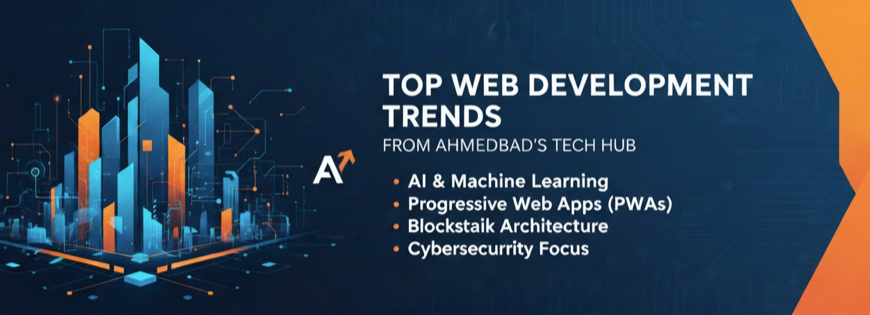
As the “Silicon Corridor” between Gandhinagar and Ahmedabad expands, the local tech hub is setting new standards in web architecture. Here are the top web development trends emerging from this vibrant ecosystem that are shaping the future of the internet in 2026.

1. The Era of Agentic AI and Autonomous Workflows
We have moved past simple chatbots. The biggest trend in 2026 is the integration of Agentic AI. Unlike the generative models of 2023, these AI agents are “action-oriented.” In Ahmedabad’s tech labs, developers are building websites where AI doesn’t just answer questions it executes tasks.
From autonomous customer success agents that troubleshoot technical issues in real-time to AI-driven procurement systems that manage inventory, the focus is on creating web platforms that function as independent workers. This shift toward “agentic workflows” allows businesses to scale operations without a proportional increase in human overhead.
2. Hyper-Personalization via Predictive UX
Static user interfaces are a thing of the past. Modern web development now utilizes Predictive UX (Anticipatory Design). By leveraging machine learning models, websites can now forecast what a user needs before they even click.
Ahmedabad-based firms are at the forefront of this, designing interfaces that adapt dynamically based on a visitor’s past behavior, geographic location, and even real-time intent. For a US-based e-commerce site, this means the entire homepage layout, product recommendations, and call-to-action buttons can change instantly to maximize conversion for every individual user.
3. Progressive Web Apps (PWAs) & “Offline-First” Resilience
As mobile internet usage surpasses 5 billion users globally, the line between native apps and websites has blurred. Progressive Web Apps (PWAs) are no longer a luxury they are a necessity.
The current trend focuses on Offline-First Resilience, ensuring that users in areas with inconsistent connectivity (or those traveling) can still interact with the core features of a site. By using advanced service worker APIs and intelligent caching strategies, developers are building web experiences that are lightning-fast, installable, and capable of sending push notifications just like a native iOS or Android app.
4. Headless Architecture and Modular Backends
Scalability is the primary concern for growing enterprises. The transition to Headless CMS and Modular Backends allows businesses to decouple their content from the presentation layer.
| Feature | Monolithic Architecture | Headless Architecture (2026 Trend) |
| Flexibility | Limited by the platform’s constraints | Full creative freedom for frontend |
| Performance | Slower due to heavy integrated code | High-speed, API-driven delivery |
| Scalability | Difficult to scale individual parts | Independent scaling of microservices |
| Omnichannel | Hard to push to different devices | Easy delivery to Web, App, IoT, and AR |
By adopting an API-first approach, companies can push content to multiple channels websites, smartwatches, and even VR headsets from a single source of truth.
5. Sustainable “Green” Web Development
In 2026, digital sustainability has moved from a corporate social responsibility (CSR) goal to a core technical requirement. “Green” web development focuses on reducing the carbon footprint of digital products.
Ahmedabad’s tech hub is leading this charge by implementing:
- Efficient Coding: Reducing the energy required for browsers to render pages.
- Edge Computing: Using serverless architectures (like AWS Lambda or Vercel) to run logic at the “edge,” closest to the user, which reduces data travel and energy consumption.
- Minimalist Design: Prioritizing performance-first aesthetics that load faster and use fewer resources.
6. Enhanced Security with DevSecOps
With the rise of sophisticated cyber threats, security is no longer an afterthought added at the end of a project. The trend is now DevSecOps, where security protocols are baked into the development lifecycle from day one. This includes automated vulnerability scanning, secure authentication through biometrics, and compliance-by-design for global standards like GDPR and HIPAA.
Why Ahmedabad is the Gateway to Global Innovation
The emergence of the Gujarat IT & AI City adjacent to GIFT City has forged a powerful synergy where global finance converges with deep-tech innovation.
This strategic ecosystem has successfully drawn top-tier talent and industry titans like IBM, Microsoft, and Nvidia to the region, solidifying its status as a premier technology destination.
For businesses in Denver and across the United States looking to pioneer new solutions, the Ahmedabad tech hub provides a rare advantage: world-class technical expertise paired with a sophisticated understanding of the American market.
This allows for the agile implementation of cutting-edge trends ranging from autonomous AI agents to sustainable green hosting at a globally competitive scale. To see how these innovations have already transformed international businesses, you can explore our client success stories and testimonials from across the globe.